

A heat-recovery unit can bring fresh air indoors while reclaiming 60% to 90% of energy, helping reduce heat lost through ventilation. For homes in Marbella, installing a heat-recovery unit means balancing airflow, duct layout and the building’s existing ventilation. The right design matters as much as the equipment.
It’s reasonable to want better ventilation without losing conditioned air or facing an unclear installation project. This guide explains how heat recovery works, what affects installation costs and timing, and which practical details help you assess a local installer for instalación de recuperadores de calor en Marbella.
You’ll also learn how system type, property layout and airflow requirements shape the design. With these factors in mind, you can understand what the work involves and what to expect, from planning through installation.
Key Takeaways
- Understand how a heat-recovery unit brings in fresh air while recovering energy from outgoing air.
- See how property layout, ductwork and system design influence installation costs and the work involved.
- Learn what can affect the installation schedule and which project details matter when considering financing.
- Use practical criteria to assess an installer’s technical approach, experience and proposed system design.
- Compare cross-flow, counterflow and rotary systems to understand which type may suit your home.
Factors affecting installation costs
The price depends on the project, with the estimate based on the home’s layout, ductwork, equipment choice and installation access. A straightforward renovation with accessible ceiling voids is different from a project requiring new routes through finished rooms. These conditions affect labour, materials and the amount of interior work.
Ventilation needs can vary between new and existing homes, so the design should reflect the property and the work being carried out. For an existing property, requirements depend on the building and the scope of work, so the design must account for the ventilation system and how it integrates with the home.
In an existing home, installation starts with a survey of the rooms, available ceiling or wall space, and possible locations for exterior air intakes and exhausts. The design then maps duct routes from the unit to each room, electrical connections and how openings will be finished. Once installed, the system is balanced and its operation checked. Each additional route through a finished interior can add work and disruption.
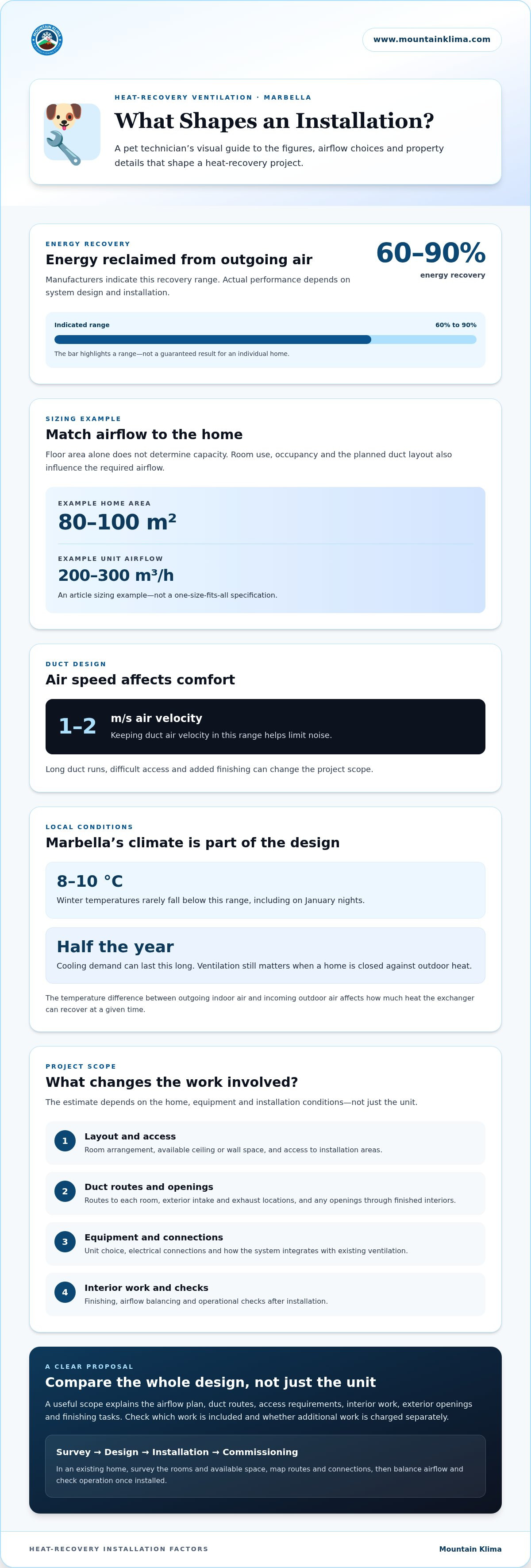
Capacity must match the home rather than its floor area alone. As a sizing example, an 80-100 m² home may use a unit with airflow of 200-300 m³/h. Room use, occupancy and the planned duct layout also influence the required airflow. Duct design affects comfort: keeping air velocity between 1 and 2 m/s helps limit noise. Difficult access, long duct runs or additional finishing can therefore change the project scope.
Marbella’s climate influences both system selection and operating conditions. Winter temperatures rarely fall below 8-10 °C, including on January nights, while cooling demand can last half the year. The temperature difference between outgoing indoor air and incoming outdoor air affects how much heat the exchanger can recover at a given time. Ventilation also continues to matter when the home is closed against outdoor heat.
Technology is another cost factor. Heat-recovery ventilation manufacturers indicate energy recovery of 60% to 90%, but system design and installation affect real-world performance. Compare the proposed unit, airflow plan, duct routes and access requirements as one project, not as separate equipment choices. A clear scope identifies what work happens indoors, where the exterior openings sit, and which finishing tasks are included.
Treat this as a labour reference when assessing the installation, not the price of the complete ventilation project. A daily rate alone won’t tell you how many days the work will take, which materials are included, or whether finishing and commissioning are covered. Check these details in the written scope before comparing proposals.
Ask installers which tasks are included in their labour estimate and how the routes, access conditions and interior work affect the expected duration. Clarify whether additional work is charged separately, and check that the scope includes airflow balancing and operational checks. Comparing proposals on the same basis helps separate equipment costs from installation work and shows what the final project price covers.
Installation duration and financing
A realistic schedule starts with a site survey, followed by design, installation, commissioning and handover. Each stage depends on access, duct routes and existing electrical arrangements. A compact retrofit with usable ceiling space differs from a project that needs new openings and extensive finishing. Agreeing on the tasks before work begins helps you plan room access and manage disruption.
For comparison, aerothermal system installation in Marbella usually takes a few days. Larger or more technically complex projects may take approximately one week. These figures describe aerothermal work, not a fixed schedule for every heat-recovery ventilation installation. For ventilation, the number of rooms served, duct access and finishing requirements determine the sequence. A clear plan shows which rooms are affected and when each task will take place.
Before installation, the design team can map the equipment position, duct routes, intake and exhaust openings, and connection points. The work may include preparing openings, fitting ducts and securing the unit. Commissioning follows, with airflow balanced, controls tested and operating guidance provided. In an occupied home, coordinating the work room by room can help limit disruption.
Financing questions often include Spanish tax relief. Under Real Decreto-ley 19/2021, the described IRPF deductions applied to qualifying works completed and documented before 31 December 2024. That deadline has passed for new installations. The described deduction levels included 20% where heating or cooling demand fell by at least 7%; 40% where non-renewable primary energy consumption fell by 30%, or the home achieved an A or B energy rating; and 60% for comprehensive renovations improving a building’s overall energy efficiency. Available deduction amounts can depend on the type of qualifying energy-efficiency work.
Those incentives required energy performance certificates before and after the work to document the improvement. If reviewing past eligibility, keep the project records together, including the system specification, invoices and certificates. For a future project, assess the budget against the full scope: equipment, ductwork, electrical work, access and finishing. Solar energy can be part of a home’s wider efficiency plan, but it doesn’t change the ventilation installation schedule by itself.
Existing climate-control faults can also affect project sequencing if equipment needs attention before other work. Where the issue concerns air-conditioning operation, air-conditioning fault repairs address that separate problem.
Choosing a professional installer
For a Marbella home, choose an installer who can explain the ventilation design, not just specify equipment. Heat-recovery ventilation involves fresh-air supply, stale-air extraction, duct routes and commissioning. The installer should connect each design choice to the rooms served and the building layout. This practical explanation helps you compare proposals by scope, rather than by equipment alone.
Start by assessing relevant experience. Ask for examples of completed ventilation projects in homes with a similar layout, such as a villa with limited ceiling space or an apartment undergoing renovation. Air-conditioning or heating experience is useful background, but it doesn’t by itself demonstrate expertise in balanced ventilation. Look for a clear explanation of how the proposed system handles both incoming and outgoing air.
A detailed proposal should describe the work in practical terms. Check whether it identifies:
- The proposed unit location and access needed for future filter changes.
- Supply and extract points, with duct routes shown against the home’s rooms.
- Exterior intake and exhaust positions, including how the openings fit the building.
- Electrical connections, commissioning and handover instructions.
- Any ceiling, wall or interior finishing work included in the project.
Use those details to compare like with like. For example, one quote may include duct installation and finished openings, while another covers equipment only. Differences in scope can affect both the work and the final result. If technical terms appear, the installer should explain how they apply to your home, rather than relying on general product claims.
Commissioning is another important point to discuss. After installation, the system needs to be tested and its airflow adjusted to match the design. Ask how the installer will explain the controls, filter access and routine care at handover. A clear demonstration helps you operate the equipment and recognise when maintenance is due.
Local knowledge can help with site planning in Marbella and the wider Málaga area. An installer familiar with occupied homes can explain how the team will access rooms, protect finished surfaces and schedule work around household routines. For a renovation, discuss who will coordinate openings and finishing. These details make the plan more specific than a standard equipment recommendation.
Review the written scope, equipment description and handover process together. Make sure the proposed system, ductwork and installation tasks match the rooms and intended use. The technician should explain the design in clear language, identify what the project includes and provide operating instructions. This gives you a sound basis for deciding whether the proposal meets your home’s ventilation needs.
Finding local installers
Search specifically for ventilation and climate-control specialists serving Marbella. Check that the business works locally and can assess your property in person. A company familiar with Málaga province may understand common villa and apartment layouts, but location alone doesn’t establish ventilation expertise. Confirm that the proposed service covers heat-recovery ventilation, not just heating or standard air-conditioning.
Online ratings can help you identify candidates, but read what the reviews actually describe. One listing of Marbella air-conditioning installers reports an average rating of 9.2 from 1,347 reviews. That figure reflects the listed installers overall, not heat-recovery projects specifically. Look for reviews that discuss installation quality, communication, commissioning or follow-up, and treat those details as more useful than a star score alone.
Use a short comparison process to narrow your options:
- Record whether each installer explicitly handles mechanical ventilation and heat recovery.
- Ask for a site assessment covering your rooms, access and existing systems.
- Compare written scopes for equipment, ductwork, commissioning and handover.
- Check whether the proposal explains maintenance access and filter replacement.
A quote that identifies supply and extract points gives you more to assess than one listing equipment alone. Compare the routes, proposed airflow and exterior openings with your home’s layout. The design should also explain how the system will be tested during commissioning. This connects the proposed design to how the equipment will operate in practice.
Discuss Marbella’s temperature conditions as part of the assessment. Choose a system for the home’s ventilation needs and intended use, not solely by a headline efficiency figure. Ask how the design handles incoming and outgoing air, and how the controls work in different seasons. A clear explanation helps you understand how heat recovery relates to ventilation performance.
Before agreeing to the work, read the scope and schedule carefully. Confirm which rooms need to be accessible, how finished surfaces will be protected, and which interior or exterior finishing tasks are included. Ask who will explain the controls and provide operating instructions. When comparing proposals for a Marbella home, prioritise a site-specific design and documented commissioning over general efficiency claims.
What types of heat recovery ventilation systems are suitable for homes in Marbella?
A home’s suitability depends on the heat exchanger, available space and ventilation layout. Cross-flow, counterflow and rotary exchangers transfer heat between outgoing stale air and incoming fresh air. Efficiency figures can help compare designs, but the best fit also depends on installation constraints, maintenance access and how the system will serve each room.
A cross-flow exchanger passes the two air streams across one another. Its stated efficiency is around 50-70%, making it one option where a simpler exchanger design fits the project. Counterflow models direct the streams in opposite directions and are described as reaching 80-90% efficiency. That higher range can be attractive, but equipment performance alone doesn’t determine the result. Duct design and correct commissioning matter too.
Rotary exchangers use a rotating wheel to transfer heat between the air streams. Their stated efficiency is around 70-85%. This type can be considered where the equipment layout accommodates a rotating element and its maintenance. Compare all three types by asking how each proposed unit suits the home’s space, air routes and access needs. A compact apartment renovation, for example, may have different constraints from a villa with room for a central unit.
System layout matters as much as exchanger type. A centralised system serves several rooms through ductwork, while a decentralised system places ventilation equipment at individual points. In a home with limited ceiling voids, routing ducts through every room can be difficult. Accessible service spaces may make a central system more practical. The design should explain air supply and extraction room by room.
Marbella’s mild winters and long cooling season also inform the choice. Winter temperatures rarely fall below 8-10 °C, including on January nights, while cooling demand lasts half the year. A heat-recovery system supports ventilation; it doesn’t replace a separate heating or cooling system. Consider how fresh-air supply will work alongside the home’s existing climate control throughout seasonal changes.
Use this comparison to guide your discussion with an installer:
- Cross-flow: around 50-70% stated efficiency; compare its design with the available installation space.
- Counterflow: 80-90%; assess duct routes, unit access and commissioning alongside its efficiency range.
- Rotary: around 70-85%; include access for inspection and maintenance in the equipment layout.
For any option, ask for the proposed exchanger type, room-by-room airflow plan and access arrangements in writing. This lets you compare systems against your home’s actual layout instead of choosing solely by the highest efficiency figure.
MountainKlima: AC Repair & Ducted AC Installation
Mountain Klima can help with air-conditioning work alongside a home ventilation project. Contact the team if an existing air-conditioning system has a fault, or if you’re planning ducted climate control as part of improvements to your home.
Services include air-conditioning repairs, installation of ducted, cassette and split systems, electronic control board repairs, and steam cleaning and disinfection of filters. These services address climate-control equipment. Heat-recovery ventilation is a separate system with its own design and installation requirements. Keeping the distinction clear helps you plan related work without confusing ventilation with heating or cooling.
If your project includes an air-conditioning issue or a new ducted system, contact Mountain Klima to discuss the work for your home in Marbella.
Plan the next step for your home
Before moving ahead with a heat-recovery installation in Marbella, prepare a short project brief. Note which rooms matter most, how the home is used during the day and what you want the ventilation system to address. This gives the technical discussion a clear starting point and links the design to everyday routines.
Consider how the work will fit around life at home. Identify rooms that need to remain accessible, note your preferred timing and consider how ventilation should work alongside existing climate control. These practical details make the planning conversation more focused without assuming every home needs the same setup.
If your plans also involve climate-control work, contact MountainKlima to discuss your home’s needs. A clear starting brief can help you move forward with confidence and make informed decisions for your property.
Frequently Asked Questions
How does a heat-recovery unit work?
A heat-recovery unit transfers heat between outgoing indoor air and incoming outdoor air through a heat exchanger. The two air streams follow separate paths, allowing the system to ventilate the home while recovering some heat from extracted air. In cooler weather, that recovered heat warms incoming air; in warmer conditions, the transfer can help limit heat entering from outdoors. The unit doesn’t replace air-conditioning or heating.
How much does heat-recovery ventilation installation cost in Marbella?
The price depends on the project, with the estimate based on its scope. System capacity, duct materials, access, electrical work and finishing all affect the cost. For example, a home with accessible service spaces may need different preparation from a renovation requiring new routes through finished rooms. Compare written scopes to see what each estimate covers.
Which Marbella companies install heat-recovery ventilation systems?
Choose a Marbella installer whose written proposal specifically covers heat-recovery ventilation design, installation and commissioning. MountainKlima serves the area with related climate-control work, including air-conditioning installation and repairs. This is relevant if your project also involves existing climate-control equipment. Keep the ventilation and air-conditioning scopes distinct, so the proposed work addresses the system you need rather than treating the two as interchangeable.
What factors affect the cost of installing a heat-recovery system in Marbella?
The building layout and ventilation duct routes are major cost drivers. A home with suitable ceiling voids may need less alteration than one where routes pass through finished ceilings or walls. Equipment capacity, the number of rooms served, exterior openings, electrical connections and finishing work also shape the scope. For a useful comparison, assess each proposal against the same rooms and installation tasks.
How long does heat-recovery ventilation installation take?
The schedule depends on access, duct routes, the number of rooms and finishing requirements. Work may involve preparing openings, installing ducts and equipment, then testing and adjusting airflow before handover. In an occupied property, room access may need to be coordinated around residents’ routines. Ask for the work sequence and identify tasks that could affect access to bedrooms, living areas or ceilings, so you can plan around the installation.
What maintenance, noise, and condensation issues can heat recovery ventilation systems have?
Clean or replace filters every three to six months, depending on outdoor dust and pollution, and clean the heat exchanger once a year. Keeping duct air velocity between 1 and 2 m/s helps limit noise.