
If my air conditioner is not dehumidifying, it may still cool the room because cooling and moisture removal are related but not identical. During a cooling cycle, moisture condenses on the cold evaporator coil and drains away. The system removes humidity as a by-product, rather than controlling it independently. An oversized unit may cool the space and switch off too quickly to remove enough moisture.
The air can feel clammy even when the thermostat shows a comfortable temperature. Low refrigerant can weaken both cooling and moisture removal, while a dirty filter, restricted airflow or blocked drain can also interfere with the process.
This guide explains how air conditioners dehumidify, why yours may cool without making the air feel drier, and how refrigerant levels and unit size affect performance. You’ll learn which signs may point to a maintenance issue and when persistent humidity calls for a technical assessment, particularly during warm, humid periods on the Costa del Sol.
Key Takeaways
- Air conditioners remove moisture when water condenses on the cold evaporator coil during cooling; they don’t independently control temperature and humidity.
- Compare how split, ducted, portable and window units handle moisture, and consider whether a dedicated dehumidifier is better suited to persistent dampness.
- Dirty filters, coils or a blocked condensate drain can interfere with moisture removal, so maintenance matters as well as cooling performance.
- Low refrigerant can reduce an air conditioner’s ability to absorb heat and moisture; refrigerant issues need professional assessment rather than DIY adjustment.
- Unit size affects run time and humidity control: an oversized system may switch off too soon, while an undersized one may struggle to cool the space.
Why your ac is cooling but not removing humidity?
An air conditioner removes moisture when its cooling cycle causes water vapour to condense on the evaporator coil. In a Costa del Sol home, the air may still feel damp if the unit cools quickly, runs only briefly, or has a fault that limits heat transfer.
If my air conditioner is not dehumidifying, understanding the evaporator coil, cooling cycle and refrigerant levels can help explain why.
For a visual explanation of the problem, watch this video:
Moisture Removal During Cooling
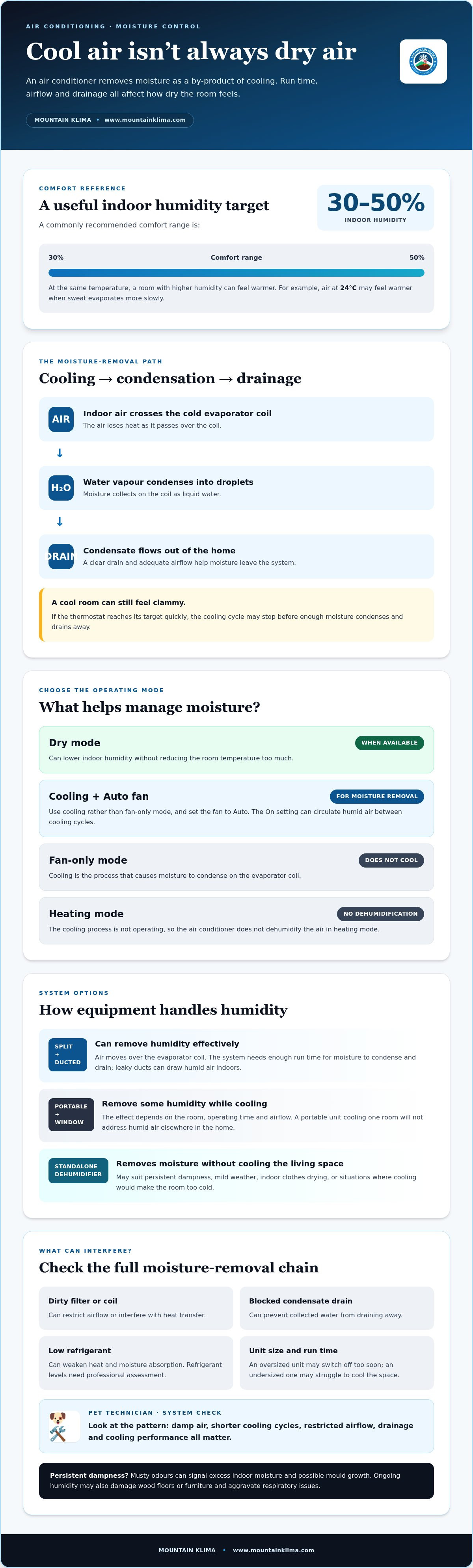
Air conditioning removes moisture as indoor air passes over a cold surface during cooling. The air loses heat, and some of its water vapour condenses into liquid water.
The system must run long enough for condensation and drainage to occur. If the room reaches the thermostat setting quickly, the cooling cycle may stop before enough moisture leaves the air. The room can then feel clammy despite being cooler.
Evaporator Coil Moisture Removal
The evaporator coil is the cold indoor component where water vapour condenses into droplets. The droplets collect on the coil and flow into the condensate drain, carrying moisture out of the home.
Both parts of this process matter. If water cannot drain away or airflow across the coil is restricted, moisture removal can suffer. For example, a blocked drain may prevent condensate from exiting the system. The coil may cool the air, but that alone does not confirm effective dehumidification.
Incidental Dehumidification
An air conditioner dehumidifies incidentally: it removes moisture as a by-product of cooling rather than controlling humidity independently. Its main job is to lower the air temperature, and the amount of moisture removed depends partly on how long the cooling cycle runs.
This explains why a cool room can still feel damp. In mild, humid weather, the thermostat may reach its target before the system has run long enough to dry the air. In heating mode, the cooling process is not operating, so it does not dehumidify the air.
Refrigerant Levels and Moisture Removal
Refrigerant carries heat through the air-conditioning system, and low refrigerant levels can reduce its ability to absorb heat and moisture. A leak or incorrect charge can therefore affect both cooling performance and the coil’s role in condensation.
Look at the overall pattern rather than treating dampness as proof of a refrigerant fault. If the unit also struggles to cool or its performance has changed, refrigerant levels are one possible cause among several system issues. A technician can assess the refrigerant charge and determine whether a leak or incorrect amount is affecting the cooling cycle.
Are modern AC units better at controlling humidity?
Modern air conditioners remove humidity during cooling, but they don’t control it independently. Indoor humidity between 30-50% is a commonly recommended comfort range; in Spain, use cooling mode, select dry mode when available, or use a dehumidifier to reduce moisture without overcooling.
Humidity Control Across AC Unit Types
Split and ducted systems can remove humidity effectively by moving air over their evaporator coils. This can help in a Costa del Sol home during warm, humid weather, provided the system runs long enough for moisture to condense and drain away.
Portable and window units can remove some humidity as they cool. Their effect depends on the room, operating time and airflow across the coil. A portable unit cooling a single room, for example, won’t address humid air elsewhere in the home.
Duct condition matters too. Leaky air-conditioning ducts can draw humid air from outdoors or other spaces into the system and circulate it indoors. Cooling the room may not solve this ongoing source of moisture. Both system performance and the path humid air takes through the home affect comfort.
Humidity Targets Without Overcooling
A practical indoor humidity target is 30-50%, a comfort range described by most experts. High humidity can make a room at 24°C feel warmer than another room at the same temperature with drier air, because sweat evaporates more slowly.
To reduce humidity without making the living space too cold, use dry mode if your air conditioner has it. This mode can lower indoor humidity without reducing the room temperature too much. Use cooling rather than fan-only mode when moisture removal is the goal, and set the fan to Auto. The On setting can circulate humid air between cooling cycles.
Thermostat settings also affect run time. If the unit reaches its target quickly, it may stop before removing enough moisture. A standalone dehumidifier can help in mild weather, when cooling would make the home uncomfortably cold, or when humidity remains an issue despite using the air conditioner.
Musty odours can signal excess indoor moisture and possible mould growth. Persistent dampness can also damage wood floors or furniture and aggravate respiratory issues. If a split system is the suitable option for your room, explore split air-conditioning installation as part of planning an effective cooling setup.
Do Air Conditioners Dehumidify & How Does it Work?
A standalone dehumidifier may be a better option when dampness persists in mild weather, while drying clothes indoors, or alongside condensation and cooling would make the room too cold. Unlike an air conditioner, it can remove moisture without lowering the living-space temperature.
For an air conditioner to remove moisture, airflow, a clean filter, a clear condensate drain and effective heat transfer at the evaporator coil all matter. These maintenance factors also affect cooling and indoor air quality.
Filter and Evaporator Coil Maintenance
Maintaining the filter and evaporator coil helps air move across the cold coil, where moisture condenses and drains away. A clean filter supports airflow, while a clean coil helps heat transfer and condensation work as intended.
Check the filter regularly and replace or clean it according to its type and manufacturer’s instructions. Changing a filter every 1-3 months is recommended to help maintain performance. Have the evaporator coils checked annually to determine whether they need cleaning. A dirty coil can reduce the system’s ability to capture moisture, even if the thermostat reaches its set temperature.
Restricted Airflow from Dirty Filters
A dirty or blocked filter restricts the air reaching the evaporator coil, reducing the system’s ability to remove moisture. Dust-covered filters, for example, can weaken airflow through a split system and leave some rooms less comfortable while the unit runs.
Look for reduced airflow from the indoor vents or a filter visibly coated in dust. These signs point to a possible maintenance issue, not necessarily a refrigerant fault. Follow the filter instructions for cleaning or replacement, and do not operate the system without its filter. Restricted airflow can also affect air quality by limiting how effectively the system circulates indoor air.
Dirty Coils, Filters, and Drain Lines
Dirty filters, dirty coils and blocked condensate drains can each disrupt a different part of moisture removal. A clogged drain, for instance, can prevent condensate from leaving the system properly. The air conditioner may still cool, but water is not draining as intended.
Maintenance should consider all three components rather than focusing only on the filter. Regular coil cleaning, filter changes and drain-line checks help maintain dehumidifying performance. If water doesn’t drain or cooling weakens despite a clean filter, arrange a technical assessment rather than opening internal components. Switch off power at the circuit breaker before anyone works inside a central AC system. For filter care, professional air-conditioning maintenance can address cleaning and system upkeep.
Incorrect refrigerant levels
Low refrigerant levels can reduce an air conditioner’s ability to absorb heat and moisture. If indoor air stays damp while cooling performance weakens, a refrigerant leak or incorrect charge may be affecting the system.
If you suspect a refrigerant leak or drainage problem, arrange an assessment by a qualified HVAC technician. Do not handle refrigerant levels or leaks yourself. Contact a technician if cooling and moisture removal decline or condensate fails to drain away.
Refrigerant carries heat through the air-conditioning circuit. In cooling mode, it helps the cold evaporator absorb heat from indoor air. If the charge is too low or incorrect, heat transfer can suffer, reducing the coil’s ability to condense water vapour. Less condensate may then collect and drain away.
A damp room alone does not prove there is a refrigerant fault. Consider the full picture: the air conditioner may run but struggle to lower the room temperature, while the indoor air remains uncomfortable. That combination points to a system performance issue worth diagnosing, not a reason to add refrigerant without testing.
Refrigerant problems can result from a leak or an improper charge. Adding refrigerant without finding the cause does not repair a leak, and an incorrect charge can continue to impair performance. A qualified technician can test refrigerant levels, assess the system and make repairs to restore cooling and moisture removal.
Drainage is a separate part of moisture removal. Water that condenses on the evaporator should travel through the condensate line and exit the system. If the line is clogged, water cannot leave as intended, even when the coil is producing condensate. A drain problem and a refrigerant problem therefore require different checks.
Notice whether the problem is weak cooling, water that does not drain, or both. Standing water near the indoor unit, for example, points to a possible drainage concern, while reduced cooling alongside persistent dampness merits a refrigerant assessment. These observations help describe the fault, but do not identify its cause on their own.
Do not open the refrigerant circuit or attempt a recharge. A leak or incorrect charge needs professional assessment, and persistent drainage trouble also calls for technical attention. A technician can distinguish a blocked condensate route from a refrigerant fault and address the specific cause, rather than treating every damp room as a low-charge problem.
Oversized and undersized air conditioners
Air-conditioner size affects run time, cooling and moisture removal. An oversized or undersized unit can leave the indoor air feeling sticky, even when the thermostat setting seems reasonable.
AC Sizing and Humidity Control
Correct sizing matches an air conditioner’s capacity to the home’s cooling load. This matters because the system needs suitable run time and airflow to cool the space and remove moisture.
An undersized unit may run for long periods but still struggle to meet cooling needs, leaving humidity high. A living room that stays warm during the hottest part of the day, for example, may indicate that the system cannot meet demand. High humidity can make the room feel even less comfortable.
An oversized unit can cool the air quickly, then switch off before the cooling process removes enough moisture. The room reaches the thermostat setting, but there has been less time for moisture to condense on the evaporator coil and drain away. Short run times can leave the air feeling damp.
Room size alone does not determine the right capacity. A load calculation considers the home’s cooling requirements and can help establish whether the existing unit is too large or too small. In a Costa del Sol home, note whether the problem affects one room or the whole property, and whether it occurs during peak cooling demand.
Oversized Systems and Short Cycling
Short cycling occurs when an oversized air conditioner repeatedly starts, cools the room quickly and stops before running long enough to remove sufficient moisture. This pattern can leave indoor air cool but sticky.
Check whether the unit switches off soon after reaching its setting, then starts again as the room warms. This may suggest short cycling, although thermostat settings or another system fault can also affect run time. Note when it happens and which rooms feel damp. These details can help distinguish a sizing issue from a problem affecting the wider system.
Setting the thermostat much lower does not correct an oversized unit. It may make the room colder without addressing why the cooling cycle ends quickly. Lowering the setting on an undersized unit will not add the capacity it lacks, either. If run-time patterns and comfort suggest a sizing mismatch, a professional load calculation is the useful next step.
If sizing points toward a different system, explore air-conditioning installation options for the home’s cooling requirements.
MountainKlima: Reparación de aires acondicionados Instalación de Aire Acondicionado por Conductos
MountainKlima can help when persistent humidity comes with weak cooling, repeated short cycles or signs of a system fault. Its air-conditioning repair service addresses malfunctioning equipment, while ducted air-conditioning installation may suit a home that needs a different system configuration or capacity. For reduced airflow linked to dirty filters, MountainKlima also provides steam cleaning and disinfection of filters.
Refrigerant issues and drainage faults need technical assessment, not DIY adjustments. If the room remains damp after routine filter care or cooling performance changes, describe those symptoms when arranging a repair. The cause may involve system condition, airflow or sizing, so the appropriate response depends on the fault identified.
Contact MountainKlima to discuss your air-conditioning issue.
Choose the right next step for your AC
If my air conditioner is not dehumidifying, note what happens before arranging a repair: whether cooling has weakened, water drains properly, and the issue affects one room or the whole home. These details give a technician a useful starting point and help distinguish a system fault from a comfort issue that may need a different approach.
Mountain Klima repairs air-conditioning systems, including electronic boards for cassette systems, and provides steam cleaning and disinfection of filters. The right service depends on the fault: filter cleaning addresses dirt, while technical repair is appropriate when performance changes or a system component malfunctions. Ducted installation may be an option when the home needs a different system configuration.
Share the symptoms and discuss the suitable next step with MountainKlima. Ask MountainKlima about your AC, and move toward a more comfortable indoor space with clear technical guidance.
Frequently Asked Questions
Can adding ventilation help reduce humidity?
Ventilation helps only when the incoming air is drier than the indoor air. On a humid day on the Costa del Sol, opening windows may bring more moisture inside instead of drying the room. Ventilate when outdoor conditions are less humid, and close the windows if the indoor space starts feeling damp. If humidity persists with the windows closed, look for another source, such as a leak or humid air entering through ductwork.
How do I know if my AC needs repair?
Arrange a technical assessment if cooling performance changes, the system repeatedly starts and stops, or water appears where it should not. A musty smell or damp rooms that persist after filter care also deserve attention. Note which rooms are affected and whether the unit cools normally, as these details help describe the fault. Mountain Klima provides air-conditioning repairs for faults that interfere with system operation.
So What Can You Do?
Start with simple observations: confirm the system is set to cooling or dry mode, inspect the accessible filter, and check whether indoor airflow feels weaker than usual. Note whether water drains normally and whether the issue affects one room or several. These clues can help distinguish a routine filter problem from a drainage, sizing or equipment fault. Do not open the unit or adjust refrigerant components yourself.
Why isn’t my AC getting rid of humidity?
Your AC may remove too little moisture if it does not run long enough, airflow is restricted, or humid air keeps entering the home. For example, a thermostat that quickly satisfies the room can stop cooling before enough moisture has been removed. In mild, humid weather, the system may run less often. If the room stays damp despite appropriate settings and basic filter care, the cause may need technical diagnosis.
Why is my air conditioner not removing humidity?
If my air conditioner is not dehumidifying, consider whether cooling is the right tool for the conditions. An AC removes moisture as part of cooling, while a standalone dehumidifier is designed to extract moisture without further cooling the room. This distinction matters in mild weather or a persistently damp space. Check for recurring condensation or dampness, then consider whether the issue is system performance or a need for separate moisture control.
What AC settings improve dehumidification, including dry mode and fan speed?
Select cooling mode, or dry mode if your unit has it, rather than fan-only operation. Set the fan to Auto so it does not keep circulating humid air between cooling cycles. Dry mode can reduce indoor humidity without lowering the room temperature too much. Avoid repeatedly changing the thermostat to extreme settings. Observe whether the system runs steadily and whether comfort improves without making the room uncomfortably cold.
How do dirty filters, coils, or blocked drains affect AC dehumidification?
These issues can interrupt airflow or prevent collected condensate from leaving the system. Look for a visibly dusty filter, weaker airflow from the indoor outlet, or water near the unit. These observations can help identify where maintenance may be needed, but they do not establish the cause. If cleaning the accessible filter does not resolve reduced airflow, or water continues to collect, arrange a professional inspection.